
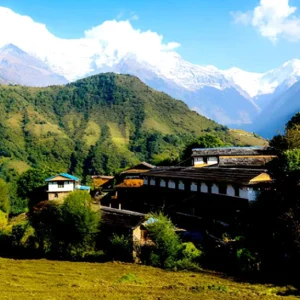
The Mustang Kingdom & Annapurna Base Camp Trek is a remarkable journey through two of Nepal’s most diverse Himalayan landscapes, combining the dramatic Kali Gandaki Valley and Lower Mustang with the spectacular mountain scenery of Poon Hill and Annapurna Base Camp. The trek brings together traditional mountain villages, ancient Buddhist culture, apple orchards, deep Himalayan valleys, terraced hillsides, rhododendron forests, high mountain landscapes, and panoramic views of the Annapurna and Dhaulagiri ranges. With its contrasting scenery and rich cultural experiences, this trek is an excellent choice for travellers seeking a varied Himalayan adventure beyond a single trekking region.
The journey begins in Kathmandu before travelling to Pokhara, the gateway to the Annapurna region. From Pokhara, a scenic flight takes you to Jomsom, where the trek enters the distinctive landscapes of Lower Mustang and the Kali Gandaki Valley. The route follows the ancient valley through Kagbeni, Marpha, Tukuche, Kalopani, and Tatopani, revealing traditional villages, dramatic mountain scenery, rivers, orchards, and the unique Himalayan environment shaped by the Kali Gandaki. From the lower valleys, the route continues towards the Annapurna region, where the landscape becomes greener as the trail leads through villages and forests towards Poon Hill and Annapurna Base Camp.
Jomsom, Kagbeni and the Kali Gandaki Valley
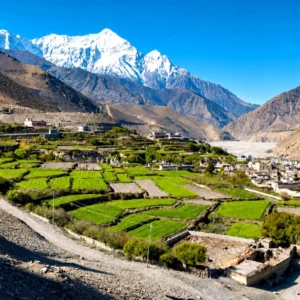
A major highlight of the Mustang Kingdom & Annapurna Base Camp Trek is the journey through Lower Mustang and the Kali Gandaki Valley. The trek begins at Jomsom, a distinctive Himalayan settlement surrounded by dry mountains and dramatic landscapes. From here, the trail follows the Kali Gandaki towards Kagbeni, an ancient village known for its traditional architecture, narrow lanes, Buddhist prayer wheels, chortens, and historic cultural character.
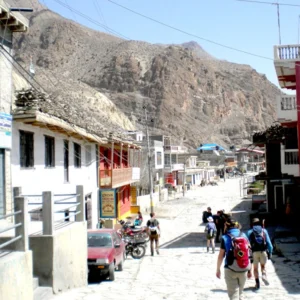
Continuing through the valley, the route passes through Marpha and Tukuche, where traditional stone and whitewashed houses, mountain scenery, and local agricultural landscapes create a strong sense of place. The Kali Gandaki corridor offers constantly changing views as the trail moves between barren mountain slopes, river valleys, orchards, and settlements. Further south, the scenery becomes greener around Kalopani and Tatopani, marking the transition from the dry landscapes of Lower Mustang towards the forested Annapurna foothills.
Lower Mustang and the Mountain Villages
The Lower Mustang section provides a fascinating introduction to the cultural and geographical diversity of the Himalayas. Traditional villages along the Kali Gandaki Valley reflect the long history of mountain communities living between the high Himalayan ranges. Buddhist heritage, stone houses, prayer flags, cultivated fields, and orchards appear alongside dramatic cliffs and mountain slopes.
The contrast between the upper and lower parts of the valley makes this section particularly rewarding. Around Jomsom and Kagbeni, the landscape is dry and rugged, while the route towards Tatopani gradually reveals greener valleys, forests, waterfalls, and terraced hillsides. This transition creates one of the defining experiences of the trek, as the landscape changes naturally from the Himalayan rain-shadow environment of Mustang to the lush foothills of the Annapurna region.
Poon Hill and Panoramic Himalayan Views
From the Kali Gandaki Valley, the journey continues towards Poon Hill, one of the most celebrated viewpoints in the Annapurna region. The trail passes through traditional villages and forested hillsides before reaching Ghorepani, an important stop on the route to Poon Hill.
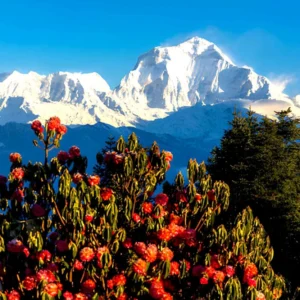
An early morning hike to Poon Hill provides an opportunity to watch the sunrise over the surrounding Himalayan peaks. As the first light reaches the mountains, the panorama opens across the Annapurna and Dhaulagiri ranges, creating one of the most memorable viewpoints of the journey. The combination of mountain scenery, forest trails, traditional villages, and sunrise views makes the Poon Hill section a natural bridge between Lower Mustang and the higher Annapurna trekking route.
Trekking Towards Annapurna Base Camp
After Poon Hill, the Mustang Kingdom & Annapurna Base Camp Trek continues deeper into the Annapurna region. The landscape becomes increasingly green as the trail passes through rhododendron forests, mountain villages, terraced slopes, and narrow valleys. The route gradually gains altitude while the surrounding mountains become more prominent.
The trek eventually enters the Annapurna Sanctuary, a spectacular high mountain valley surrounded by some of the region’s most impressive peaks. As the trail approaches Annapurna Base Camp, the character of the landscape changes once again, with forests giving way to rugged alpine terrain and expansive Himalayan views. The journey through the sanctuary offers a striking contrast to the dry landscapes experienced earlier in Lower Mustang.
Annapurna Base Camp and the Return Journey
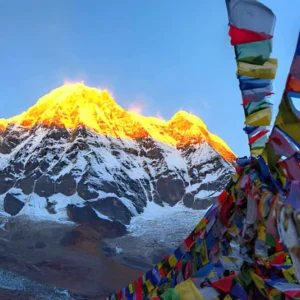
Reaching Annapurna Base Camp is the culmination of the second major section of the trek. Located within the Annapurna Sanctuary, the base camp provides an immersive high-Himalayan experience surrounded by towering mountains. The dramatic scenery, changing landscapes, and sense of arrival make this one of the defining moments of the Mustang Kingdom & Annapurna Base Camp Trek.
After spending time at Annapurna Base Camp, the trail descends through the Annapurna region towards lower valleys and traditional settlements. As the altitude decreases, forests, terraced hillsides, and warmer landscapes gradually return. The journey eventually continues towards Pokhara, where the trek concludes before returning to Kathmandu.
With its combination of Lower Mustang, the Kali Gandaki Valley, Jomsom, Kagbeni, Marpha, Tukuche, Tatopani, Poon Hill, Ghorepani, the Annapurna Sanctuary, and Annapurna Base Camp, the Mustang Kingdom & Annapurna Base Camp Trek offers an exceptional journey through two distinctly different Himalayan environments. The contrast between Mustang’s dry mountain landscapes and the green valleys and high peaks of the Annapurna region makes this trek particularly appealing to European travellers looking for cultural depth, varied scenery, and a rewarding Himalayan trekking experience. The Mustang Kingdom & Annapurna Base Camp Trek brings together the best of the Kali Gandaki Valley, Poon Hill, and Annapurna Base Camp in one diverse and memorable adventure.
Trip Highlights
-
Mustang’s Living Cultural Heritage – Discover ancient traditions, historic monasteries, and village life shaped by centuries of Himalayan and trans-Himalayan culture.
-
Unique Trans-Himalayan Scenery – Journey through wind-carved cliffs, dry valleys, barren hills, and striking desert-like landscapes found across Upper Mustang.
-
Historic Lo Manthang – Visit the ancient walled city of Lo Manthang, the former royal capital where traditional architecture and cultural heritage endure.
-
Tibetan Buddhist Traditions – Experience prayer flags, sacred monasteries, spiritual landmarks, and Buddhist traditions deeply connected with the region’s identity.
-
Annapurna Base Camp Sanctuary – Trek into the spectacular Annapurna Sanctuary, surrounded by towering Himalayan peaks and dramatic snow-covered mountain scenery.
-
Remarkable Landscape Diversity – Experience striking contrasts between high-altitude desert terrain, green forests, alpine meadows, and glacial mountain environments.
-
Culture and Himalayan Scenery – Combine authentic cultural encounters with dramatic mountain landscapes for a diverse and memorable trekking experience.
-
Ancient Villages and Monasteries – Explore remote settlements, centuries-old monasteries, traditional homes, and cultural landmarks reflecting Mustang’s unique heritage.
-
Remote Himalayan Adventure – Travel through isolated mountain landscapes and traditional communities, experiencing the distinctive character of Nepal’s northern Himalayas.